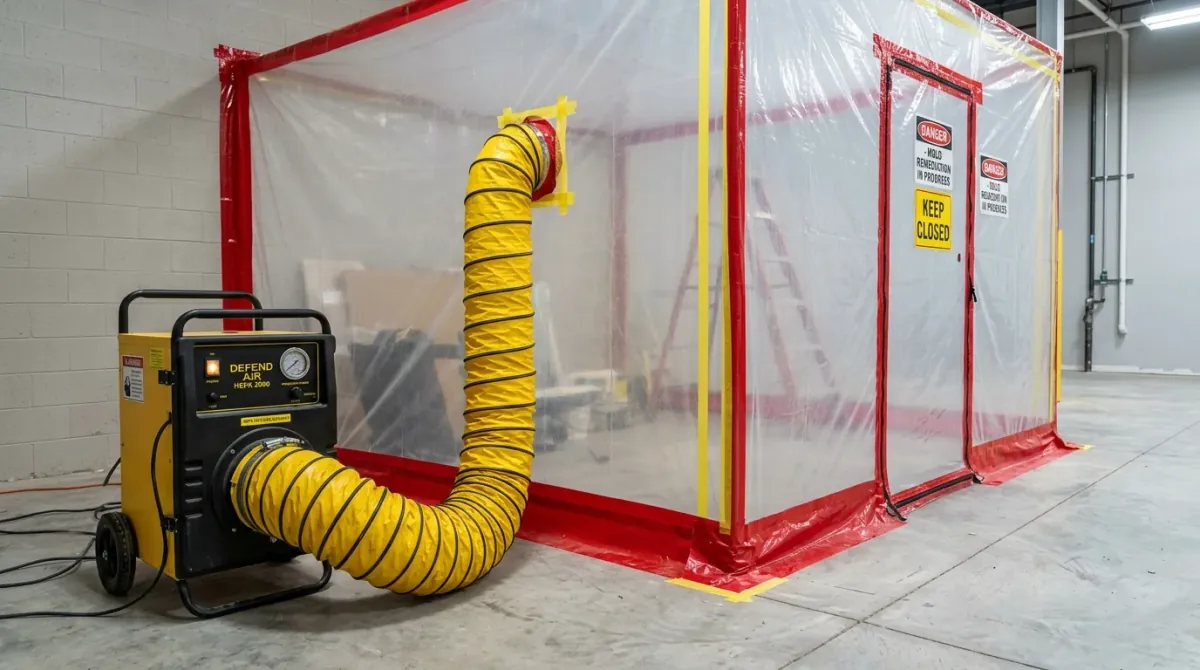
Operating occupied commercial facilities requires strict adherence to ANSI/IICRC S520 remediation standards to protect building occupants, staff, and visitors from airborne bioaerosols. Commercial remediation projects tackle complex HVAC air handling contamination, drop ceiling water leaks, and extensive wallboard damage across large floor plans. Technicians construct multi-chamber decontamination airlocks, deploy multi-unit negative air scrubbing arrays, and sanitize mechanical air plenums using hospital-grade antimicrobial solutions. Scheduling flexible after-hours demolition preserves business continuity, while rigorous third-party clearance air testing verifies that commercial spaces meet environmental health thresholds.
Remediation Procedure & Containment Measures
1
Multi-Zone Airlock Containment
Airtight poly partitions and negative air zones isolate occupied commercial tenant spaces.
2
Commercial HVAC Decontamination
Air handler coils, return plenums, and supply trunks are cleaned and treated with EPA antimicrobials.
3
Off-Hours Strategic Demolition
Contaminated drop ceilings and drywall are removed during nights or weekends to protect business operations.
4
Independent Clearance Testing
Third-party industrial hygienists conduct aggressive air clearance testing before releasing the space.
Suspect Active Microbial Growth Behind Your Walls?
Speaking directly with our technical team allows immediate scoping of containment needs before spores circulate into HVAC returns.
Containment zones isolate work areas behind multi-chamber airlocks, while heavy demolition and air scrubbing can be scheduled during night shifts or weekends to maintain tenant safety and minimize operational downtime.
Remediation follows ANSI/IICRC S520 guidelines, incorporating continuous negative-pressure HEPA filtration, sealed waste load-out procedures, and continuous indoor air monitoring to prevent bioaerosols from reaching public common areas.
Technicians isolate duct segments under negative pressure, clean interior duct walls with motorized rotary brushes and HEPA collection units, and sanitize cooling coils and drain pans using EPA-registered hospital-grade antimicrobials.
Porous acoustic ceiling tiles and saturated gypsum board with microbial growth cannot be restored and must be removed inside containment. Hard non-porous surfaces like steel studs and structural concrete undergo thorough decontamination and seal coating.
Facilities receive comprehensive project documentation, including daily moisture logs, photographic progression records, hazardous waste disposal manifests, and third-party post-remediation clearance inspection certificates for tenant and insurance files.
High-volume commercial desiccant dehumidifiers extract moisture from large open retail floor plates, concrete slabs, and structural steel framing rapidly, preventing secondary microbial growth.
Supply and return air diffusers in the affected zone are mechanically blocked and sealed with heavy poly film, isolating HVAC circulation between the remediation area and occupied tenant spaces.
An independent third-party environmental consultant or industrial hygienist collects aggressive air and surface samples before containment walls are dismantled, ensuring impartial verification of indoor air quality.
Schedule Commercial Mold Remediation
Direct phone consultation assesses contamination severity, containment protocols, and rapid technician dispatch.
Stop Spore Spread Before Mold Damages Your Property
Unchecked moisture allows fungal colonies to expand behind baseboards, sheetrock, and insulation within 48 hours. Immediate structural containment prevents spore colonization throughout your indoor living space.