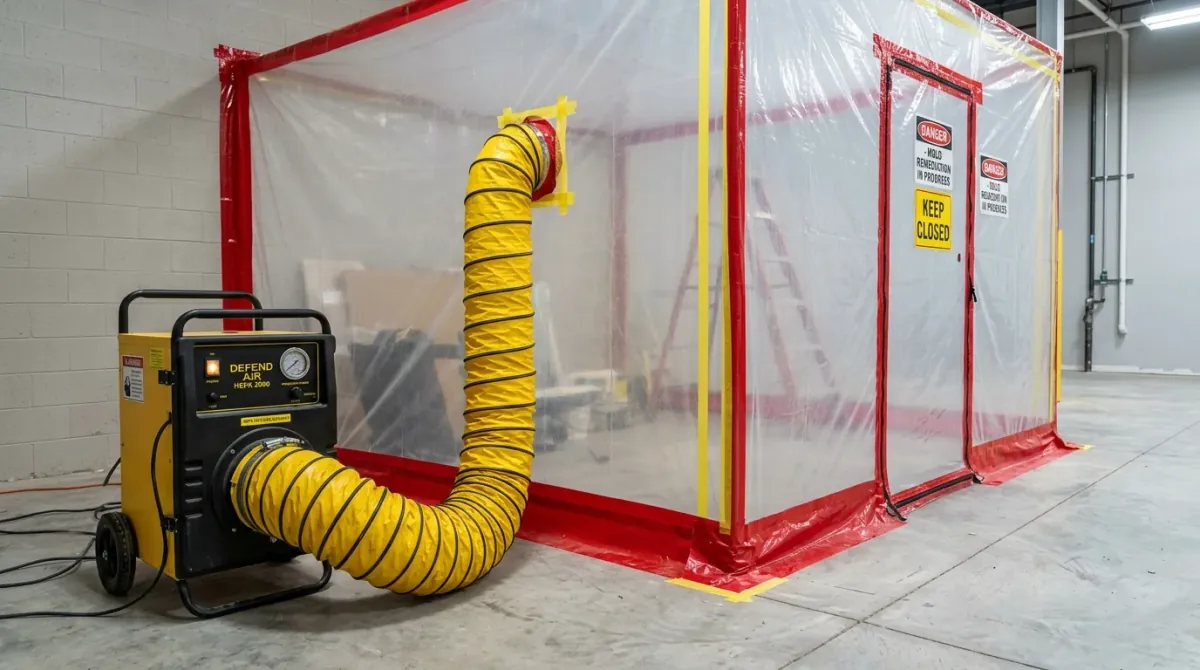
Persistent musty odors, plumbing leaks, and elevated indoor humidity trigger rapid microbial growth on drywall, subflooring, and timber framing across Mississippi. Targeted containment barriers and negative-pressure HEPA filtration halt airborne spore migration before structural decay compromises your indoor living space.
Professional Mold Remediation & Removal Services in Mississippi
Subterranean crawl spaces and unsealed basement foundations throughout Mississippi face relentless soil vapor pressure, elevating indoor relative humidity above sixty percent. Constant capillary moisture rising through porous concrete creates ideal incubation conditions for dark Aspergillus and Penicillium colonies along wooden subflooring. Over time, that persistent subterranean dampness rots floor joists and spreads musty odors into living areas upstairs.
Standard household dehumidifiers lack the capacity to reverse saturated structural timber once fungal mycelium establishes deep root networks in damp floor framing. Effective remediation requires sealing crawl space floors with reinforced twenty-mil vapor barriers, extracting damp fiberglass batts, and deploying industrial desiccant drying systems to draw moisture out of the framing.
Technicians representing Mold Remediation Pros systematically scrape colonized joists, apply EPA-registered antimicrobial encapsulants, and verify that framing lumber drops below fifteen percent wood moisture equivalent. These rigorous diagnostic procedures eliminate active fungal growth while establishing long-term protection against future groundwater vapor intrusion.
Specialized Remediation Services in Mississippi
Black Mold Removal: Toxic Stachybotrys chartarum eradication targeting colonies embedded in drywall, subflooring, and framing lumber under strict negative air containment.
Basement & Crawl Space Mold Remediation: Subterranean fungal extraction and moisture control eliminating moisture-driven mold colonies from damp foundation walls, rim joists, and subflooring.
Mold Inspection & Testing: Diagnostic moisture mapping, thermal imaging inspections, and accredited laboratory air cassette analysis to identify hidden structural mold contamination.
Commercial Mold Remediation: Large-scale containment, HVAC decontamination, and structural mold removal engineered for office buildings, retail facilities, schools, and multi-family complexes.
Remediation Protocol Overview
Thorough containment setup protects unaffected living areas while demolition commences within contaminated zones in Mississippi. Commercial air machines pull thousands of cubic feet of air through true HEPA filters every hour, maintaining negative pressure so hazardous fungal particulate cannot drift into adjacent hallways or bedrooms during drywall removal.
Contaminated building materials are bagged inside the containment zone before transport to prevent spore release through the residence. Technicians abrade all remaining structural joists, treat subflooring with deep-penetrating fungicidal washes, and run commercial dehumidifiers until moisture readings meet established structural dry standards required for third-party clearance testing.
Remediation protocols tailored to vulnerable structural zones across Mississippi:
Mildew grows as a flat, powdery gray or white film on non-porous surfaces like tile grout and wipes away cleanly with household detergents. Stachybotrys chartarum appears slimy, dark greenish-black, and embeds deep roots into organic building materials. A professional tape lift or swab sample evaluated under a microscope provides conclusive species identification.
Microbial volatile organic compounds create that signature musty odor as hidden fungal colonies digest cellulose behind baseboards, beneath carpet pads, or inside rim joists. Ground moisture migrating through porous concrete foundation walls elevates relative humidity above 60%, fueling active spore germination out of plain sight.
Pre-testing is optional when substantial visible growth is already obvious, as remediation protocols remain focused on physical removal regardless of species. However, baseline testing becomes invaluable when diagnosing phantom musty odors, resolving real estate transaction disputes, or establishing legal documentation for insurance carriers.
Occupants generally remain home if the affected area is confined to an isolated room, crawl space, or attic with independent exterior ventilation. Larger remediation projects involving whole-house HVAC contamination or heavy structural tear-outs often require temporary relocation for individuals with respiratory vulnerabilities, asthma, or compromised immune systems.
Third-party clearance testing confirms remediation success through calibrated air cassette sampling and optical microscopy analysis. Particle counts inside the contained work zone must drop below ambient outdoor baseline levels, with zero presence of toxic marker species like Stachybotrys chartarum before containment plastic comes down.
Request Remediation in MS
Direct phone consultation assesses contamination severity, containment protocols, and rapid dispatch across Mississippi.
Stop Active Mold Growth in Your Mississippi Property
Unchecked moisture allows fungal colonies to expand behind baseboards, sheetrock, and insulation within 48 hours. Rapid structural containment prevents spore colonization throughout your indoor living space.